API vs ACEA Engine Oil Standards: What's the Difference and Which One Matters for Your Vehicle?
It can be confusing to choose the right engine oil when all the bottles look covered in technical codes. You might encounter the labels API SN, API SP, API CK-4, ACEA A3/B4, ACEA C3, or ACEA E9 and be confused about which one is relevant to your vehicle. To most drivers, such codes read like marketing language and are not meant to decorate. They give you the answer to whether the oil fits your engine, whether you are driving in harsh or gentle conditions, and the level of protection your vehicle requires.
The importance of engine oil standards lies in the fact that modern engines are more advanced, smaller, and more delicate than older engines. Lubricants are subjected to severe demands due to turbochargers, emission systems, diesel particulate filters, catalytic converters, and high-temperature operating conditions. Improper oil use may reduce engine protection, increase wear, reduce fuel economy, damage emission systems, and even cause warranty issues. That is why it is necessary for every vehicle owner to understand the distinction between API and ACEA engine oil standards.
Why Engine Oil Standards Exist
Engine oil does far more than just lessen friction between moving parts. It helps regulate heat, prevents metal-to-metal contact, minimizes deposits, defends against corrosion, keeps interior components clean, and facilitates easy engine operation. Not all oils are engine oils, however. A small petrol vehicle, a European diesel SUV, a heavy-duty truck, and a turbocharged modern sedan might need various levels of oil performance.
Engine oil classifications come in at this point. Standards like API and ACEA provide vehicle owners, repairers, and fleet operators with a reliable way to know what an oil should do. You should not rely only on the brand or viscosity (5W-30, 15W-40); also ensure that you have the right performance standard for the oil. Viscosity indicates how the oil flows at various temperatures, and ACEA and API indicate how effectively the oil protects the engine under certain conditions.
What Are API Engine Oil Standards?
API is the abbreviation of the American Petroleum Institute. API standards are widely used in North America and in most markets around the world. They categorize engine oils based on the petrol and diesel engine performance needs.
The petrol engine oils in the API system typically take the first letter of S, whereas the diesel engine oils take the first letter of C. As an illustration, API SN and API SP are petrol engine oil classifications, whereas API CK-4 is a diesel engine oil classification. With the change in the second letter, it tends to be a newer or more advanced standard.
The API standards concentrate on wear protection, deposit control, oxidation resistance, sludge prevention, and stability at high temperatures. The significance of these qualities is that engine oil should be able to keep functioning after heat, pressure, and long service intervals. To the everyday car driver, API rating is used to ensure that the oil has undergone established performance assessments and can be used in certain types of engines.
An example of this is API SP, which is a modern standard of petrol engine oils, intended to offer better low-speed pre-ignition, timing-chain wear, oxidation, and deposit protection. On the other hand, API CK-4 is used in engines that are heavy-duty with diesel engines that have to work in tough conditions.
What Are ACEA Engine Oil Standards?
The initials ACEA are the European Automobile Manufacturers Association. ACEA standards particularly apply to European vehicles, which are widely used in Europe, the Middle East, Africa, and other countries where European vehicle technology is prevalent.
The ACEA engine oil classifications are typically indicated in letters and numbers, e.g., ACEA A3/B4, ACEA C3 or ACEA E9. These classes will indicate what kind of engine and performance needs the oil will fulfill. ACEA A/B types are typically those used in petrol and light-duty diesel engines. Engine emission-control systems, like catalytic converters and diesel particulate filters, are placed in ACEA C categories. The ACEA E categories cover heavy-duty diesel engines.
A significant factor that makes ACEA standards significant is the fact that a lot of European engines have extremely specific chemical properties that must be met by oils. There are engines that require low-SAPS oil, i.e., oil with low sulfated ash, phosphorus, and sulfur. This is particularly necessary in cars having diesel particulate filters since when the incorrect oil is used, it can augment the accumulation of ash and reduce the duration of the emission system. High‑SAPS oils increase DPF ash loading.
API vs ACEA: The Main Difference
The main difference between API and ACEA is the way each system approaches engine oil performance. The API standards have a close association with the North American engine specifications and are more concerned with wear protection, deposits, oxidation control, and the overall engine life. ACEA standards are more directly related to European engine designs, emission systems, fuel economy targets and longer drain intervals.
In simple terms, API informs you on whether an oil is performing to a known level of performance with petrol or diesel engines; whereas ACEA provides more detailed advice on European-style engine requirements and technologies to meet emission regulations. This does not imply that one system is necessarily more superior than the other. It implies they cater to different markets and designs of engines.
To illustrate, an automobile manufactured in the American market may need an API SP oil. ACEA C3 may be needed in a European diesel car with a DPF. Depending on the recommendation of the engine manufacturer, a commercial diesel truck can be in need of API CK-4, ACEA E9, or both.
Does Your Vehicle Need API or ACEA?
The right solution is the recommendation of your car maker. The best manual to refer to is your owner's manual, as it will provide you with the type of oil that you should use in your engine. There are those vehicles that refer to API standards alone. There are others that refer to ACEA standards. Most of the modern oils have both since they are meant to cater to various vehicle markets.
ACEA standards can be of particular importance to you in case you drive a European car like Mercedes-Benz, BMW, Volkswagen, Audi, Peugeot, Renault, Volvo, or some European diesel cars. Their vehicles tend to be very demanding in terms of oil due to the presence of turbochargers, emission control mechanisms, as well as high-performance engine designs.
If you drive an American, Japanese, or Korean car, API standards can be used more frequently. This is not, however, a rule. Most of the cars that are sold in the UAE and Middle East are imported from various areas, and the only sure solution is to adhere to the specification that the manufacturer has given and not to assume based on the origin of the car.
Why This Matters in Hot Climates
Engine oil standards are even more important in hot regions like the UAE and the Middle East. Stress on engine oil is augmented by high ambient temperature, idle conditions, traffic jams, heavy use of air-conditioning, dusty environments, and driving on highways. In such circumstances, the quality of the oil or its improper specifications may oxidize more easily, thin out under heat, or create deposits and lose its protective properties.
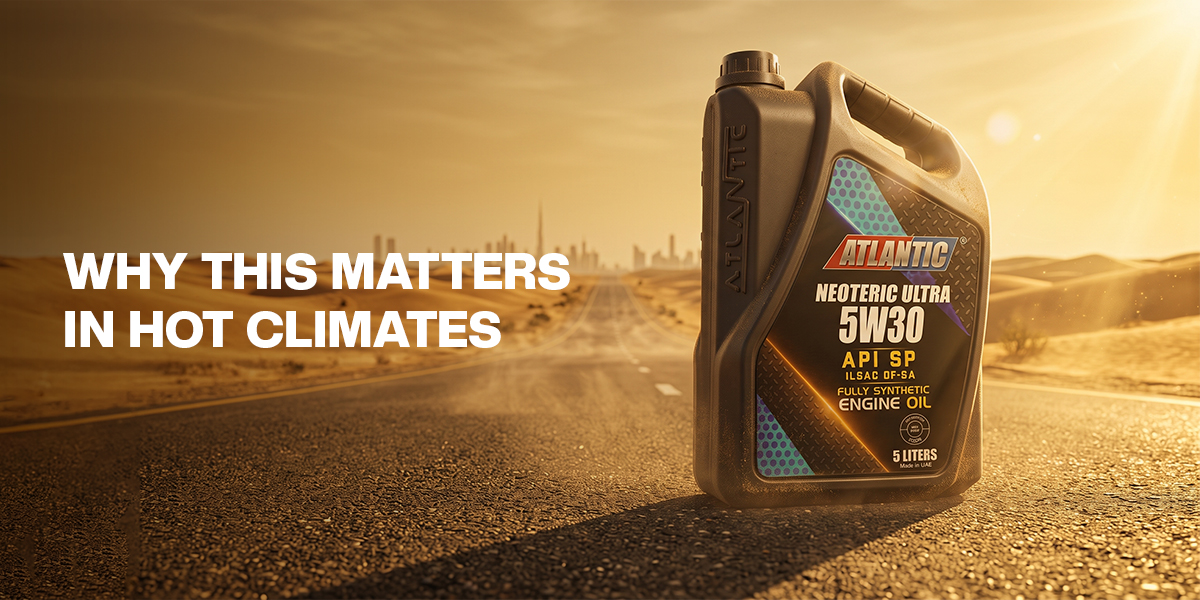
Engine protection during high thermal stress is maintained with a properly certified oil. It maintains the separation of moving parts, guarding turbochargers, aids in the sludging down of engines, and assists in keeping the engine cleaner in the long run. This is particularly critical in vehicles that are used every day during summer heat, commercial vehicles, delivery vehicles, cabs, SUVs, pickups, and diesel engines that are operating under load.
It is not sufficient to choose oil based on viscosity only. A 5W-30 oil, which does not meet the correct standard, will not be able to protect your engine, but a 5W-30 oil with a 5W-30 API or ACEA certification can be the one your car is looking for. The grade of viscosity is as important as the specification.
Why Some Oils Carry Both API and ACEA Certifications
Most of the good engine oils have an API and an ACEA certification since cars are currently being sold in international markets. A lubricant producer can formulate an oil that meets both North American API and European ACEA standards. This can be useful for drivers, workshops, and fleet owners as it is more compatible.
Dual certification, however, does not imply that the oil is compatible with all engines. You must still meet the exact requirement in your owner's manual. For example, a specific oil may be API SP and ACEA C3, but if your car needs ACEA C2 or a manufacturer-specific approval, you must follow that specification.
Another significant layer is manufacturer approvals. Other brands have specifications like Mercedes-Benz MB 229.51, BMW Long-life, VW 504.00/507.00, or other approvals. These certifications are usually based on API or ACEA requirements with additional manufacturer-specific testing.
Common Mistakes Vehicle Owners Make
The first one is that newer oil is always better. A newer API type can provide better protection; however, it must also be compatible with your engine. Newer API categories are backward compatible only in petrol engines, not always in diesel. The other error is that any oil with the correct viscosity is okay. The oil can also flow properly, but its additive chemistry might not be suitable for the engine.
The other problem is that an API-rated oil may be used in a vehicle in Europe without verification of compliance with ACEA requirements. This may be unsafe when using an engine with a DPF or low-SAPS oil. Likewise, it may not be the best to use a European-spec oil in an engine that requires a specific API diesel classification.
Classification of diesel oil is also not followed by drivers. High-power diesel engines require robust protection against soot, oxidation, deposits, and wear. Standards like API CK-4 and ACEA E9 are in place because diesel engines are not used under the same conditions as petrol engines.
How to Choose the Right Oil with Confidence
To select the best engine oil, it is better to start with the vehicle manual to find the viscosity grade and performance standard. When your manual needs API SP 5W-30, make sure that you select a label that indicates API SP. If your manual requires ACEA C3 5W-30, select an oil that clearly meets the ACEA C3 specification. If you need both, ensure they are indicated.
You are also to take your driving environment into consideration. In the UAE and the Middle East, oils with high quality, oxidation resistance, and heat stability are particularly useful. Oils in hot climates should be able to provide protection under extreme thermal conditions, particularly in engines that operate for long hours or carry heavy loads.
It is also important to purchase oil from a reliable supplier. Fraudulent, low-quality, or incompatible oils can cause severe issues in the long run. The right oil protects your engine, improves fuel economy, reduces maintenance risk, and helps your vehicle perform reliably.
Choose Atlantic Grease and Lubricants for the Right Engine Oil
Knowing the API and ACEA engine oil standards will help you make a more informed decision, but quality and trust remain the key to choosing the right product. Atlantic Grease and Lubricants offers high-quality engine oils that meet recognized API and ACEA standards, as well as the real-world requirements of cars operating in harsh climates.
Whether you drive a petrol, diesel, European, pickup, or heavy-duty commercial engine, the right choice of oil is one of the easiest ways to protect your investment. To get reliable oils that suit your vehicle, visit Atlantic Grease and Lubricants and choose products designed to protect engines, perform on the road, and last.